

Floor Repair Contractors in Maryland & Northern Virginia
5.0-star Google rating · 500+ reviews · MHIC #104041 · Licensed & Insured
Get A Free Quote Today!
Calls answered or returned the same day, Saturdays included.
A dip in the hallway, a board that moves underfoot, a squeak that started one winter and never left, gray boards in front of the dishwasher, a dark patch where the dog kept missing the pad. These are repairs. Done right, a repair costs a fraction of replacing a floor that is mostly fine, and when the furniture goes back you should have to point the spot out.
AG Construction is a floor repair contractor working across Maryland and Northern Virginia, the same MHIC-licensed company that installs and refinishes hardwood every day. We look at the floor and under it where access allows, tell you plainly whether the problem is a flooring fix or something bigger, and give you a free written estimate either way. Call 240-246-4561 or request a free assessment online.
What We Repair
Sagging & Bouncy Floors
Dips, slopes and bounce usually trace to the subfloor and the support under it. We open the floor from above, correct what belongs to the floor system, and relay the finish floor so the repair disappears.
Subfloor Repair & Replacement
Soft spots, panels that have pulled loose, sections ruined by water or age. We cut out and replace what has failed, re-fasten the rest and level it, as a repair or as prep for new floor.
Water Damaged Boards
Cupped, crowned or blackened boards after a leak. Dry first, then an honest call between sanding flat, replacing the worst boards, or fixing the subfloor underneath.
Pet Stains
Dark urine stains that have soaked into the wood do not sand out. We cut out the affected boards, lace in new ones and blend the finish so the room reads as one floor.
Squeaks, Gaps & Loose Boards
Squeaks are movement. We find each one and fasten it properly instead of covering it up, and we fix gaps that stay open year round.
Board Replacement & Lacing In
Gouges, burns, splits and sections cut out for old walls or ducts, replaced with matching boards laced into the existing floor rather than a straight patch.
Sagging Floors and Floor Joist Repair
Sagging floor repair contractors get called for three different problems, and only an assessment tells them apart. The first is subfloor panels that have gone soft, delaminated or pulled loose from the joists. The second is support directly under the floor system that needs sistering or blocking. The third is real structural settlement: a foundation, a beam or a post that has moved.
The first two are flooring-side repairs and exactly the work we do. We open the floor from above, correct the subfloor and the framing support that belongs to the floor system, and relay the finish floor so you cannot find the spot afterward. The third is not a flooring repair, and the most useful thing we do on those calls is say so at the free assessment, before you spend flooring money on a structural problem. You bring in a structural specialist, and when the structure is corrected we put the floor back over it properly.
Older housing stock in Montgomery County, Bethesda and Arlington makes sagging, sloping and bouncy floors one of our most common calls. If a dip or slope has opened up in your floor, or a section bounces when you walk across it, the assessment is free and the estimate is written either way.
Subfloor Repair and Replacement
The subfloor is the plywood or OSB, or in older houses the diagonal planking, that the finish floor sits on. Water, age, undersized panels and missing fasteners ruin subfloors long before the surface shows it. You notice it as a soft spot by the dishwasher, a bathroom floor that gives a little, or a run of hardwood that has started to cup for no visible reason.
We cut out and replace failed sections, re-fasten panels that have worked loose, and level the surface so the new floor goes down flat and stays quiet. Subfloor work is either a standalone repair or the prep step before new hardwood or luxury vinyl plank, and it is priced the same way either time: after we have seen it. If you searched for who repairs subfloors, the answer is a flooring contractor, and it is a normal part of our week.
Water Damaged Hardwood Boards
Water gets into hardwood from a dishwasher line, a refrigerator, a toilet seal, a window left open in a storm or a basement that took on water. The wood swells, the boards cup at the edges or crown in the middle, and the finish goes cloudy or black where the water sat.
The first step is drying. A floor that is still wet cannot be judged, and sanding it flat too early means it moves again once it dries. After drying, the triage is honest: some floors flatten out and only need sanding and refinishing, some need the worst boards cut out and replaced, and some have a subfloor underneath that has to be addressed first. Black staining that has gone deep into the grain usually means a board replacement rather than a sanding, and we tell you which one you have. Whole floors that have been through a flood are restoration work, and that page covers it.
Pet Stains and Urine Damage
Pet urine that sits on a floor works into the wood and turns the boards dark, sometimes black, and the smell stays in the wood after the surface is cleaned. Light staining that is still in the finish layer sands out during a refinish. Staining that has soaked through the wood does not, however deep the sanding goes, and bleaching it is unreliable and weakens the board.
The durable fix for a deep pet stain is to cut out the affected boards, lace in new ones, then sand and finish the area so the repair blends with the rest of the room. Where the whole room is due for a refinish anyway, the stain repair gets folded into that job. Our flooring for dogs guide covers what holds up best afterward.
Squeaks, Gaps and Loose Boards
A squeak is movement: a board rubbing on a nail, a subfloor panel lifting off a joist, or two boards rubbing each other where the floor has dried and loosened. The durable fix is to find each one and fasten it, from above or from below where there is access, not to sprinkle powder into the gap and hope.
Gaps are usually seasonal. Wood floors shrink in the winter heating season and close up in summer, and small gaps that come and go are normal. Gaps that stay open year round, or boards that have gone loose and lift at the ends, are a repair: we re-fasten what is loose, fill or replace where a gap will not close, and blend the finish. Keeping indoor humidity steady does more to prevent gaps than any filler; our floor care guide covers the rest.
Board Replacement and Lacing In New Boards
Gouges, burns, split boards, a dark stain in one spot, a section that was cut out for an old wall or a duct: these get repaired by replacing the boards, not by hiding them. We cut out the damaged boards, and where the repair meets the existing floor we lace in the new ones so the end joints are staggered like the rest of the room instead of running in a straight patch line.
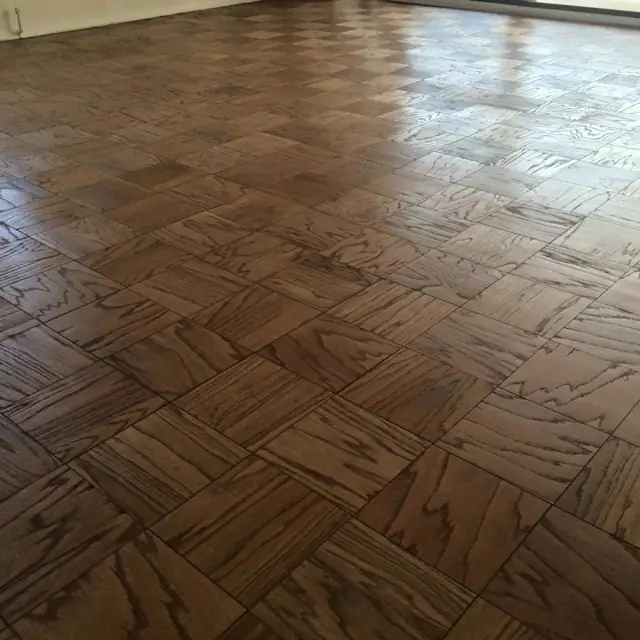
Matching matters more than anything else in a board repair. Species, grade, board width and the color the old wood has taken on over the years all have to line up, and on an older floor that can mean sourcing reclaimed material of the same species. Once the new boards are in, the area is sanded flush and finished. On a floor that has been finished in place, we usually sand and finish the whole room so the repair and the old finish do not read as two different floors; on a prefinished floor with matching product, a spot repair is often enough. Parquet, herringbone and older solid floors can almost always be repaired this way rather than replaced.
Commercial Floor Repair
Offices, shops, restaurants, church halls and apartment corridors wear floors out in patterns a house never sees: a traffic lane from the door to the counter, damage under rolling chairs, water at an entrance, a section torn up when a wall came out. We repair commercial wood floors the same way we repair residential ones, then blend the repair into the surrounding floor.
Most commercial floor repair calls turn into a repair plus a recoat or a refinish of the traffic area, because a patch finished to match one worn lane looks worse than the lane did. Tell us the hours the space is in use and the estimate will carry a schedule that works around them. See commercial floor restoration, multifamily and HOA flooring and the commercial flooring hub for how quoting and scheduling work.
Repair, Refinish or Replace: How We Decide
The right-sized answer depends on where the damage is and how much of the floor it touches. We put it into one of three buckets at the assessment, and where two are realistic you get both numbers on paper.
Repair
The problem lives in one place: a doorway, one run of boards, a bouncy corner, a single stain, a squeak. Fix that spot, blend it, and leave the rest of the floor alone. Repairs are quoted after a free assessment, not over the phone.
Refinish
The damage is spread across the surface of the whole room: thin or yellowed finish, gray traffic lanes, scratches everywhere. Repairs get folded into the refinish, and refinishing is quoted as packages; see the sanding and staining cost guide.
Replace
The boards have been sanded to their limit, the damage runs through the wood rather than across it, or the subfloor under a large area has failed. We quote replacement and say plainly why.
If the floor is structurally tired everywhere, water has been through it, or boards are missing, that is restoration: repairs first, then a full sand and finish. Our blog covers what refinishing costs in Maryland if you want the numbers before you call.
How a Repair Visit Works
First, the assessment. We look at the floor, under it where access allows, and at what caused the problem, because repairing the symptom without the cause is how you pay for the same repair twice. You get a free written estimate that says what we found and what we would do about it.
Second, honesty about scope. Most sagging and movement is corrected from the flooring side: subfloor, fastening and support as part of the floor system. When the cause is foundation settlement or needs engineered structural work, we say exactly that and you bring in the right specialist before spending money on flooring.
Third, the repair itself, finished to match. AG Construction has repaired, refinished and installed floors across the DMV since 2011, owner Aaron Goodman personally oversees every project, and the standard for a repair is simple: when the furniture goes back, you should have to point the spot out. Furniture is moved by a professional moving company we arrange.
Where We Repair Floors
We work Montgomery, Howard, Frederick, Anne Arundel, Carroll, Prince George's and Baltimore Counties in Maryland and Fairfax, Arlington and Loudoun Counties in Northern Virginia. We do not travel to the Eastern Shore or the Delaware beaches. Sagging floor and subfloor calls come to us most often from Montgomery County, including Bethesda and Rockville, from Howard County, where we are based, and from Arlington and Fairfax on the Virginia side. The full service area page lists every community we cover.
Why Work With AG Construction MD
- MHIC #104041, licensed and insured. That is the license Maryland requires, and it is verifiable on the state register.
- Owner Aaron Goodman has 15 years of hands-on flooring experience across Maryland and Northern Virginia and personally oversees every project.
- Free, written, no-obligation estimates on every commercial project, including budget numbers for work that is not approved yet.
- One contractor for hardwood, sanding, staining, refinishing, restoration, luxury vinyl, laminate and carpet, so nobody is pointing at somebody else mid-job.
- A service-area business, not a showroom. We come to the property, and there is no retail markup on the quote.
- Scheduling built around your operating hours wherever the job allows. Office hours are Monday to Friday 8am to 5pm and Saturday 9am to 5pm.
AG Construction MD LLC is based in Woodbine, MD 21797 and is a service-area business. Call 240-246-4561 for a free estimate or request a quote online.